

Choosing a sink is one of the first decisions in a kitchen remodel. It shapes how your counters look, how easy they are to clean, and what you pay for the project.
Most kitchen sinks come down to two installation styles: top mount and undermount. Here’s how they differ, and how to decide which one fits your kitchen.
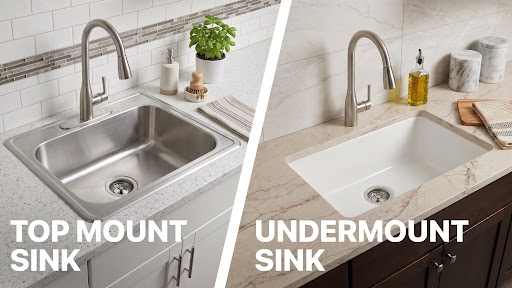
Which Sink Should You Choose?
Your countertop material settles most sink choices, because an undermount sink needs stone or solid surface.
Choose an undermount sink if you:
- Have quartz, granite, marble, or solid-surface countertops.
- Want the full countertop edge on display.
- Like wiping crumbs straight into the bowl.
Choose a top mount sink if you:
- Have laminate countertops.
- Want the simpler install.
- Have a tighter budget.
- Might swap the sink out later.
What Is a Top Mount Sink?
A top mount sink, also called a drop-in or overmount sink, installs into a countertop opening from above. Its raised rim rests on the countertop for support. Top mount sinks are affordable, easy to install, and compatible with most countertop materials.
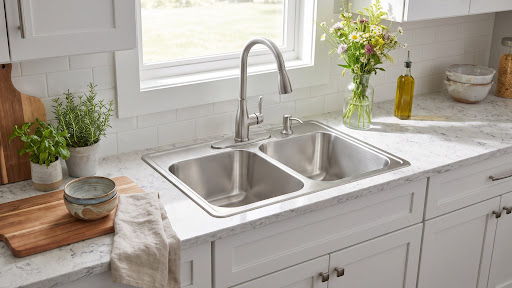
Why Homeowners Choose Top Mount Sinks
- Works with almost any countertop. Laminate, butcher block, tile, and stone can all take a top mount sink, because the rim covers the cut edge.
- Usually costs less. The sinks themselves tend to be less expensive, and installation is simpler.
- Easier to replace later. You can lift out a top mount sink and swap it without disturbing the countertop.
Top Mount Sink Drawbacks
- The raised rim means you can’t wipe crumbs and spills straight into the sink.
- The seam where the rim meets the counter can collect grime over time and needs regular cleaning.
- The rim breaks up the surface and hides part of your countertop.
What Is an Undermount Sink?
An undermount sink mounts beneath a countertop to create a seamless appearance. It simplifies cleaning by letting you wipe water and debris directly into the basin.
Undermount sinks are common in kitchens and bathrooms with solid slab countertops such as quartz, granite, marble, and solid surface.
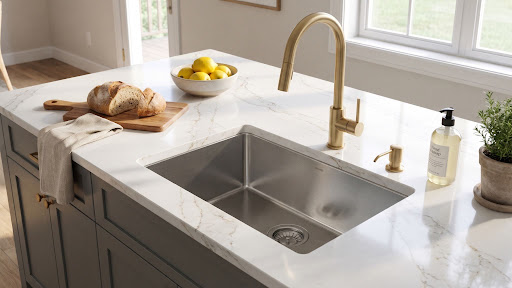
Why Homeowners Choose Undermount Sinks
- A clean, seamless look. With nothing interrupting the countertop, quartz, granite, and marble take center stage.
- Easier daily cleanup. Crumbs and spills wipe straight from the counter into the sink.
- More usable counter space. Without a rim, every inch around the sink is flat, workable surface.
Undermount Sink Drawbacks
- It needs a water-resistant countertop like quartz, granite, marble, or solid surface instead of laminate.
- It usually costs more because the sink opening needs precise fabrication and polishing.
- The underside lip of the sink needs an occasional wipe to keep buildup from collecting there.
- Swapping the sink later is a bigger job than with a top mount.
Read next: 3 Reasons To Always Choose An Undermount Sink
Top Mount vs. Undermount Sink Differences
The main difference between top mount and undermount sinks is the rim. A top mount sink’s rim rests on top of the countertop. An undermount sink hangs below the countertop with no rim in sight. That one detail drives each sink’s look, cleanup, installation, and replacement.
| Feature | Undermount Sink | Top Mount Sink |
|---|---|---|
| How it mounts | Attaches to the underside of the countertop with adhesive and metal clips | Drops into the cutout from above, with its rim resting on the countertop |
| Countertop match | Needs a solid slab such as quartz, granite, marble, or solid surface | Works with nearly any countertop material, including laminate |
| Laminate countertops | A poor fit, because the exposed particleboard edge of the cutout can swell when it gets wet | A good fit, because the rim covers the cut edge |
| Look | A clean, unbroken counter edge that makes the countertop look larger | A visible rim that sits on top of the counter and takes up some counter space |
| Wiping the counter | Crumbs and spills sweep straight into the bowl | The raised rim catches crumbs and grime |
| Seal upkeep | The caulked seam under the counter edge is harder to clean and needs recaulking about every 5 years | The rim and its seam need regular wiping to stay clean |
| Faucet holes | Usually has no predrilled faucet holes | Usually has 1 to 4 predrilled faucet holes |
| Installation | Needs a precisely fabricated, polished cutout and a professional install | Simpler to install, because the rim hides the cut edge |
| Price | Usually higher, because of the precise cutout and professional install | Usually lower |
| Replacing it later | Hard: the new sink must match the old cutout closely, and installers often remove the countertop to do it | Simpler: a new sink can usually go into the same opening without changing the countertop |
| Best for | Quartz, granite, marble, and solid-surface countertops where a clean counter edge and easy cleanup matter most | Laminate, butcher block, and tile countertops, plus budget-minded remodels |
Your sink choice also affects your faucet. Top mount sinks often have faucet holes built into the rim. Undermount setups usually have the faucet holes drilled into the countertop. Pick your faucet early, because your fabricator needs it to plan the openings.
Read next: 3 Things To Know About Farmhouse Sinks (Why We Love Them)
Get Expert Help at Our Wilsonville Design Studio
Not sure which sink is right for your kitchen? Visit the Precision Countertops Design Studio in Wilsonville, Oregon. Our team will walk you through sink styles, countertop materials, and every detail of your project. We handle design, fabrication, and installation in-house.
Schedule Your Free Design Consultation
Undermount and Top Mount Sink FAQs
Find quick answers to common questions about undermount and top mount sinks.
Can You Use an Undermount Sink With Laminate Countertops?
An undermount sink is not recommended for standard laminate countertops. Laminate has a particleboard core under its surface. An undermount sink leaves the cut edge of that core exposed. Water that reaches the core can cause it to swell. A top-mount sink is the standard choice for laminate because its rim covers the cut edge.
How Is an Undermount Sink Attached?
An undermount sink attaches to the underside of the countertop with adhesive and metal clips. The adhesive bonds the sink rim to the countertop and seals the seam between them. The clips fasten to the countertop and hold the sink tight against it. A heavy sink may also need extra support underneath.
Can You Use an Undermount Sink as a Top Mount Sink?
A standard undermount sink does not work as a top mount sink. An undermount sink has no finished rim to rest on the countertop. Undermount mounting hardware works only from below the countertop. A dual-mount sink is the exception. A dual-mount sink has a flat rim that works above or below the countertop.
Is an Undermount Sink Better Than a Top Mount Sink?
An undermount sink is the better choice for stone and solid-surface countertops. An undermount sink gives a clean counter edge and an easy wipe-down into the bowl. A top mount sink is the better choice for laminate countertops, tighter budgets, and easier replacement later. The countertop material usually decides which sink is better.
Can You Replace an Undermount Sink With a Drop-In Sink?
A drop-in sink can usually replace an undermount sink when the new rim covers the existing cutout. The drop-in sink’s rim has to rest on the countertop on every side. A drop-in sink smaller than the cutout will fall through it. Switching from a drop-in sink to an undermount sink usually means new countertops.